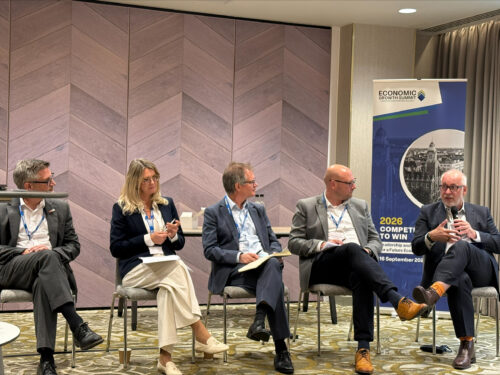

News & views
Supporting local innovation opportunities at Innovate UK roundtable
17 September 2026
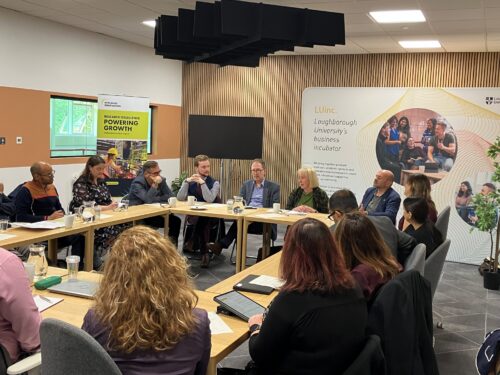
LBV recently participated in a strategic roundtable at Loughborough University, hosted by Innovate UK, exploring how combined authorities, universities and industry can work together more effectively to translate the new UKRI strategy into stronger innovation-led growth across the Midlands.
Our Chair, Sue Tilley, joined Tom Adeyoola, Executive Chair of Innovate UK, representatives from the Technology Transfer Offices of Midlands Innovation universities, Dr Lisa Smith, CEO of Midlands Mindforge, the East Midlands Combined County Authority, West Midlands Combined Authority, and West Midlands Growth Board, alongside private sector representatives including HORIBA MIRA, Rolls-Royce and The Pioneer Group
During the debate, Sue was asked for LBV’s perspective on representing an area that is not currently part of a combined authority, the challenges this creates for the business voice and the implications for access to place-based funding opportunities.
The need to ‘operate on a level playing field’
Sue explained: “There is no lack of innovation here. We have ambitious and capable businesses, but many are very frustrated and increasingly disengaged from the system.
“LBV has existed for around 20 years and does exactly what its name suggests: it provides a voice for local business. We are a small, independent organisation run entirely by volunteers. All three local universities are represented on our board and we work closely with them because we regard universities as fundamental to the future of our economy.
“We are extremely frustrated by the position in which Leicester, Leicestershire and Rutland now finds itself. Local government reorganisation and devolution appear to have become confused with one another. We have consistently advocated devolution because our businesses and our £30 billion economy need the opportunity to operate on a level playing field.
“At the moment, we are not at the table when some funding and strategic opportunities become available. Local government reorganisation may or may not proceed in its current form, but the UK cannot afford to stop investing in a £30 billion economy with such strong and innovative businesses, including companies such as HORIBA MIRA.
“How can it be right, from a national perspective, for businesses to be excluded simply because their area does not yet have a combined authority?
“Collaboration across institutions and geographical boundaries is therefore essential. We need to make sure that areas outside combined-authority structures are not left behind.”
A practical suggestion to improve access to funding
Sue continued: “I spoke last night to one of our LBV Ambassadors who has been successful in securing Innovate UK funding. She described the positive difference that funding had made, but also how difficult the process had been and how persistent she had needed to be.
“She asked me to pass on a practical suggestion: could Innovate UK create a portal where innovative businesses could register their capabilities, ambitions and interest in collaboration?
“A business may not be right for a particular funding competition at that moment, but it may be suitable for a future programme or interested in working with universities, investors, primes or other innovative businesses. A portal could create an ongoing channel through which those businesses remain visible and can be connected with future funding and strategic collaboration opportunities.
“Perhaps this could be incorporated into the funnel and referral approach that Tom has described. With the development of AI, it should now be possible to create and manage these types of connections much more effectively.
“That suggestion arose from just one conversation. Through LBV, we can have many more of those conversations, gather intelligence from businesses and help Innovate UK understand both the opportunities and the barriers within our region.”
Supporting collaboration with diverse businesses
Sue said: “Our economy is very diverse. We have strengths in food and drink, mobility, advanced manufacturing, technology and our university and science base. Yet many of our practical, grounded businesses have almost given up engaging. They ask what the point is in talking to public bodies if those bodies do not have the powers or resources to help them.
“LBV can help to bring businesses and universities together and support collaboration. We also work closely with our regional partners, including the Chamber. It is nonsensical when artificial boundaries put areas or organisations into competition with one another because businesses, clusters and supply chains do not operate according to administrative boundaries.
“My central message is that parts of this region are increasingly frustrated and risk being excluded. We need creative ways to work across the existing boundaries. LBV is willing to help Innovate UK and regional partners hear directly from our businesses and connect Leicester and Leicestershire into the wider innovation system.
Greater focus on innovation adoption
In conclusion, Sue highlighted the importance of making innovation support accessible to smaller businesses:
“It is important to remember that around 98 per cent of UK businesses are SMEs. If Innovate UK can offer programmes that those firms can genuinely access, the cumulative impact could be enormous.
“It is not always about very large individual investments or creating unicorns. Helping an SME to buy a machine, adopt technology or turn an innovation into a practical productivity gain can transform that business and, at scale, the UK economy.
“We therefore need to think much more about innovation adoption as well as invention.”
For LBV, the discussion reinforced the importance of ensuring that Leicester, Leicestershire and Rutland remains connected to regional and national innovation opportunities — and of making sure the voice and experience of local businesses helps shape how those opportunities are delivered.